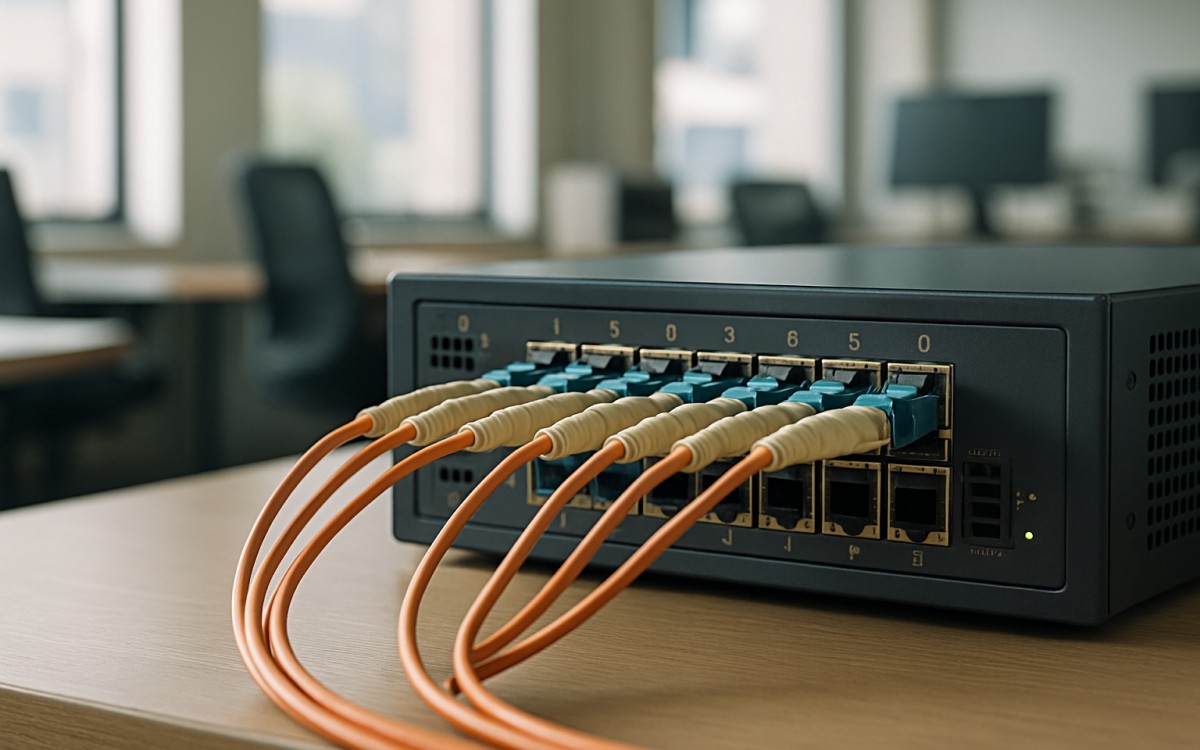
If you work in a large office, you already know the amount of data produced during a day. Every email written, every new spreadsheet saved, and every new file generated on the computer creates data, which is quickly stored in a central hub far away. But have you ever wondered how data travels from your office to a central hub with such incredible speed? The answer lies in the sophisticated technology of fibre optic cables.
What Is Fibre Optics?
To appreciate how your office connects to the wider world, we first need to look at the cables themselves. Unlike traditional copper wiring, which relies on electrical signals, fibre optics use light. These cables are composed of incredibly thin strands of glass or plastic, roughly the thickness of a human hair.
Each strand, known as an optical fibre, acts as a waveguide for light. Through a process called total internal reflection, light pulses bounce along the core of the fibre, carrying vast amounts of data over enormous distances without significant loss of signal quality. Because light travels much faster than electrical pulses through metal, fibre optics offer a level of performance that copper simply cannot match.
The Journey Begins – From the Desk to the Wall
The journey of a digital packet begins the moment you hit ‘send’ on an email or upload a file to the cloud. Inside your office, your computer translates data into electrical signals. These signals travel through local area network (LAN) cables, often Category 6 or similar, to a central switch or router located in your server room or a dedicated IT cupboard.
This is where the magic of conversion happens. A media converter or an optical transceiver within your networking hardware takes those electrical signals and transforms them into light pulses. These pulses are then fed into the fibre optic cable that runs from your office suite into the building’s vertical riser.
Navigating the Building Infrastructure
In a multi-storey office complex, the ‘vertical’ part of the journey is crucial. The building usually has a dedicated backbone of fibre optic cabling that runs from the top floor down to the basement or a primary distribution frame. This backbone is designed to handle the aggregated data traffic of every business operating within the premises.
In many modern commercial developments, this infrastructure is pre-installed. It ensures that when a new tenant moves in, the ‘last mile’ of connectivity is already waiting for them. The fibre leads to a common entry point, often referred to as the ‘Meet-Me Room’. This is a secure space where your building’s internal network shakes hands with the external service providers.
Metropolitan Area Network – The City’s Digital Arteries
Once your data leaves the building, it enters the Metropolitan Area Network (MAN). This is a vast, subterranean web of high-capacity fibre cables buried beneath the streets. These cables are often housed in protective conduits to shield them from construction work, vibrations, and environmental factors.
Local telecommunications providers manage these networks, ensuring that the light signals from your office are routed efficiently through various ‘nodes’ or exchange points. Think of these nodes as digital roundabouts that direct traffic toward its final destination. Because fibre optics are immune to electromagnetic interference, your data remains secure and clear, even when passing near heavy electrical machinery or power lines.
Reaching the Destination – The Data Center
The final stop for your office’s direct connection is the data center. This is the ‘hub’ in our story. A data center is a highly secure, temperature-controlled facility that houses thousands of servers and networking components. It is the heart of the cloud, where your software-as-a-service (SaaS) applications live and where your backups are stored.
When your fibre line reaches the data center, it enters through a diverse entry point to ensure redundancy. Inside, the light pulses are received by high-end carrier-grade routers. The information is then processed and sent to the specific server or storage array it was intended for. This entire trip, from your office keyboard to a server in a data center kilometres away, typically happens in a matter of milliseconds.
Why Light is Superior to Electricity
You might wonder why we have moved away from copper. The primary reason is bandwidth. Fibre optic cables can carry significantly more data than copper wires of the same diameter. While a copper line might struggle with the demands of a modern office, a single fibre pair can support multiple terabits of data per second.
Another factor is distance. Electrical signals in copper cables degrade quickly, requiring ‘repeaters’ every few hundred metres to boost the signal. Light, however, can travel for many kilometres before it needs any amplification. This makes it much more efficient for connecting suburban offices to a central urban data center.
Role of Splicing and Precision
Maintaining this connection requires incredible precision. Unlike copper wires that can be twisted together, joining two fibre optic cables involves a process called ‘fusion splicing’. A technician uses a specialised machine to align the glass cores perfectly and melt them together with an electric arc.
This ensures that the light can pass through the joint without scattering. Any imperfection in the splice can lead to ‘insertion loss’, which slows down your connection. This level of technical detail is why professional installation is vital for business-grade fibre.
Redundancy — The Safety Net
For a business, a lost connection is lost revenue. Therefore, most direct office-to-hub connections are built with redundancy in mind. This often involves ‘dual-entry’ or ‘ring’ topologies. If a construction crew accidentally cuts a cable on one street, the network can instantly reroute the data in the opposite direction around the ring to reach the data center.
This fail-safe mechanism is a standard feature of high-end enterprise fibre packages. It provides the peace of mind that your connection to the data center remains active even if a physical break occurs somewhere in the city.
Scalability for Future Growth
One of the most significant advantages of a fibre connection is that it is future-proof. If your company grows from fifty employees to five hundred, you often do not need to dig up the ground to lay new cables.
By simply upgrading the transceivers at both ends, your existing fibre can carry more data. Technologies like Dense Wavelength Division Multiplexing (DWDM) allow service providers to send multiple different ‘colours’ or wavelengths of light down the same fibre, each carrying its own stream of data. This effectively multiplies the capacity of the cable without any new physical infrastructure.
Low Latency and the User Experience
In a professional setting, latency is just as important as speed. Latency is the delay between sending a request and receiving a response. Because light in a vacuum is the fastest thing in the universe, and light through glass is not far behind, fibre optics offer the lowest possible latency.
This is critical for real-time applications. If your office uses Voice over IP (VoIP) for phone calls or relies on remote desktop protocols to access powerful workstations in a data center, low latency ensures there is no perceptible lag. It makes the remote server feel as if it is sitting right under your desk.
The journey from your office to the data center is a marvel of modern engineering. It involves a seamless handoff between local hardware, building infrastructure, and a vast metropolitan network of glass threads. By opting for a direct fibre connection, your business gains more than just internet access; it gains a dedicated, high-speed portal to the digital economy.
Understanding this infrastructure helps in making informed decisions about IT investments and business continuity. As we move further into a cloud-first world, the quality of these light-based connections will continue to be the defining factor in how efficiently we work and collaborate.